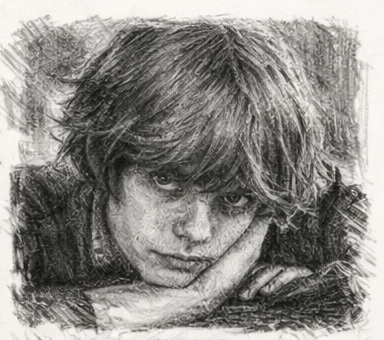
It took me a long time to realize I don’t speak the way others do. I just don’t interpret things the same.
This has become especially apparent with the newest character I’m trying to write, an autistic trans person who also happens to have “abilities.” Recently I read a post on being “bilingual” in neurotypical and neurodiverse communication, and such a concept has always fascinated me.
One thing that I’m especially interested in is how languages shape our lives, and if you follow my author blog, the stories and other works I post meet at that intersection–how language turns our lives upside-down or makes us whole. I never realized I was communicating in in-betweens, never fully getting my point across to one demographic or the other, because I was only semi-code-switching.
My new story has been difficult to write because the lead character is similar to me in many ways, but is in others very different. The person stands on their own, breathes the same air as a live human being; but they are also bound to otherworldly powers and a condition I know intimately, and yet have never spoken about plainly.
I think I’m drawn to the beauty of the margins not because I live on them, but because my experience echoes them like footsteps on an empty stairwell. The world tells me I should behave or think a certain way. People who strive for solidarity end up dividing. So is the natural order. But I can’t be contained, because there never was a way to contain me.
My character’s similarity to me is haunting, and I decided to write them as if they spoke as forthrightly as I think. Images form the basis of a lot of my thoughts, though snatches of words do, too. I’m lucky to have words. Some people go many years, or their whole lives, without using the world’s most-used form of communicative currency.
And that’s not a bad thing. That’s what I’m trying to underscore in my drafts as I cycle through them, because for all the time I’ve spent researching over the past few months about real-life people who are nonspeakers but who succeed as authors, activists, and researchers, among other occupations, I want to give them life elsewhere. To celebrate them. From what I gather, S2C (Spelling to Communicate) and new technologies augmenting it are helping these individuals succeed more than ever.
I want to document this turning point, and all those times that, even while I was gifted with speech from an early age, I felt inadequate. Speech is a double-edged sword. I can write well, better than a lot of peers at times. But because my spoken ability comes out as emotionally charged in ways people don’t expect, or zigzags inordinately, I lose the game.
My stories are unusual; this I know. And I like that about me. My poetry rhymes only if you care to look. And my writing is a passion project. But I won’t give up trying to wrest minds and hearts from their everyday concerns to the strange and the scarcely-believable.
What I write works when they, like my new character, refuse to let go of a fundamental principle: “you are your own monster. You were always becoming one. And the only escape is to embrace.”
And creating my new semi-hero, I’ve come to see this: maybe writing is more a form of folding into monstrosity than it is an act of love and likeness.
And maybe that is the language I’m fluent in.
Images by Pawel Czerwinski + Milad Fakurian.
 The Self-Styled Scholar